

With the rapid development of Industry 4.0 and intelligent manufacturing, industrial routers, as the core equipment of the Industrial Internet of Things (IIoT), are becoming an important force to promote the digital transformation of traditional industries.
How do industrial routers differ from standard routers?
Before we dive into innovation, it's important to understand what makes industrial routers different. Unlike consumer routers, industrial routers can withstand harsh environments such as extreme temperatures, vibration, exposure to dust and moisture. They provide the following functions:
High security: Enhanced protection against network threats.
Reliability: trouble-free operation 24/7.
Advanced connectivity: Support for protocols such as Ethernet, 4G, 5G and even satellite communications.
Scalability: Ability to grow with industrial networks.
In short, industrial routers are designed for high-performance environments where failure is not an issue.
Technological innovation promotes the development of industrial routers
(1) Enabling 5G technology
With the commercial popularization of 5G technology, industrial routers have ushered in a new round of technological upgrades. The high bandwidth and low delay characteristics of 5G greatly improve the efficiency of data transmission, and provide possibilities for advanced application scenarios such as remote control and AR/VR assisted maintenance. For example, in smart factories, 5G industrial routers can support high-speed data transmission, achieve real-time monitoring and remote control of equipment.
(2) Fusion of edge computing
The introduction of edge computing technology further optimizes the data processing process. By preprocessing data at the edge, industrial routers can reduce the pressure on the cloud and improve the overall performance of the system. This means that data is processed closer to the data source, reducing latency and improving efficiency and security.
(3) Strengthening cyber security
Cyber security and data encryption technologies are becoming research and development priorities in response to increasingly sophisticated industrial cyber threats. Industrial routers ensure the security and integrity of data during transmission by supporting a variety of encryption protocols and security mechanisms.industrial router
The main applications of industrial routers in various fields(1) Intelligent manufacturing
In the field of intelligent manufacturing, industrial routers are the key to realize equipment interconnection and data acquisition. Through the deployment of industrial routers, sensors, PLC (programmable logic controller), robots and other devices on the production line can upload production data to the cloud platform in real time, providing decision support for production scheduling and quality control.
(2) Remote monitoring and maintenance
Industrial routers support remote access and management, allowing technicians to monitor, diagnose and repair equipment without having to be on site. This not only reduces operation and maintenance costs, but also improves response speed and guarantees production continuity.5G Industrial Router
(3) Intelligent logistics
In the field of warehousing and logistics, industrial routers help realize the intelligent tracking and positioning of goods. Through the connection of RFID tags, AGV (automatic guided vehicle) and other equipment, to achieve accurate inventory management, logistics path optimization, improve logistics efficiency.
4. Energy management
In the energy field such as smart grid and wind farm, industrial routers are responsible for collecting sensor data, monitoring equipment status in real time, providing data support for energy scheduling and fault warning, and promoting efficient use of energy.wireless router
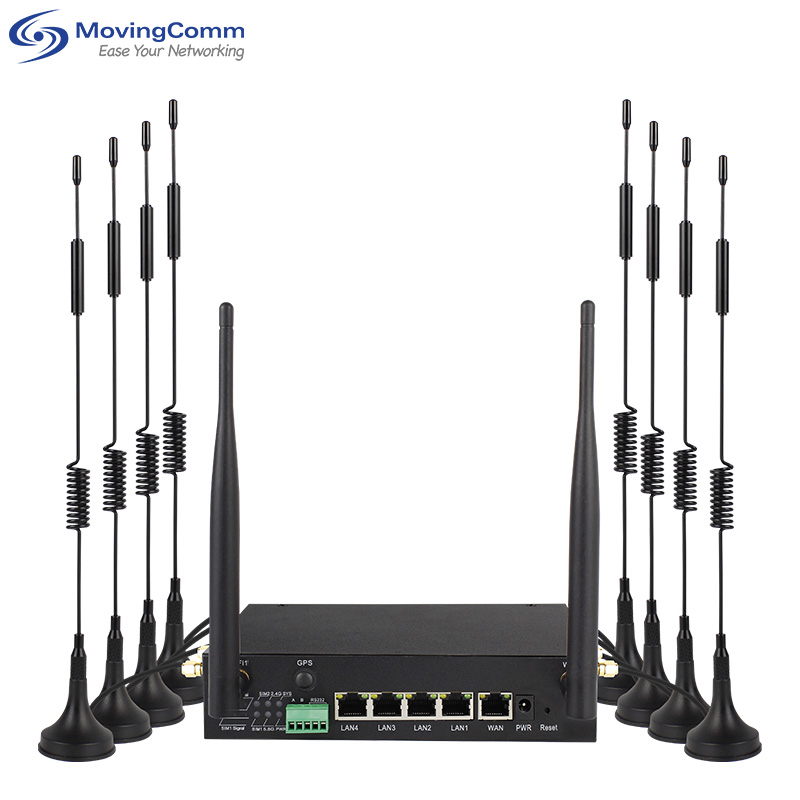
In the future, industrial routers will develop to a higher level of intelligence and edge computing capabilities. With the advancement of Industry 4.0, devices will integrate more powerful data processing capabilities to achieve data analysis and decision-making at the edge, reduce dependence on the cloud, and improve response speed. At the same time, with the maturity of low power wide area network (LPWAN) technology, industrial routers will support more Internet of Things protocols, providing a more efficient and economical solution for large-scale, long-distance industrial equipment interconnection.
In the future, industrial routers will develop to a higher level of intelligence and edge computing capabilities. With the advancement of Industry 4.0, devices will integrate more powerful data processing capabilities to achieve data analysis and decision-making at the edge, reduce dependence on the cloud, and improve response speed. At the same time, with the maturity of low power wide area network (LPWAN) technology, industrial routers will support more Internet of Things protocols, providing a more efficient and economical solution for large-scale, long-distance industrial equipment interconnection.
