

Unmanned aerial vehicle (UAV) network communication technology is the key to realizing UAV cooperative operation, data transmission and remote control. With the wide application of UAVs in military, civil and commercial fields, networking communication technology is also evolving. The following are several main UAV networking communication technologies:
Wireless local area Network (WLAN) technology
Wi-Fi (IEEE 802.11 series)
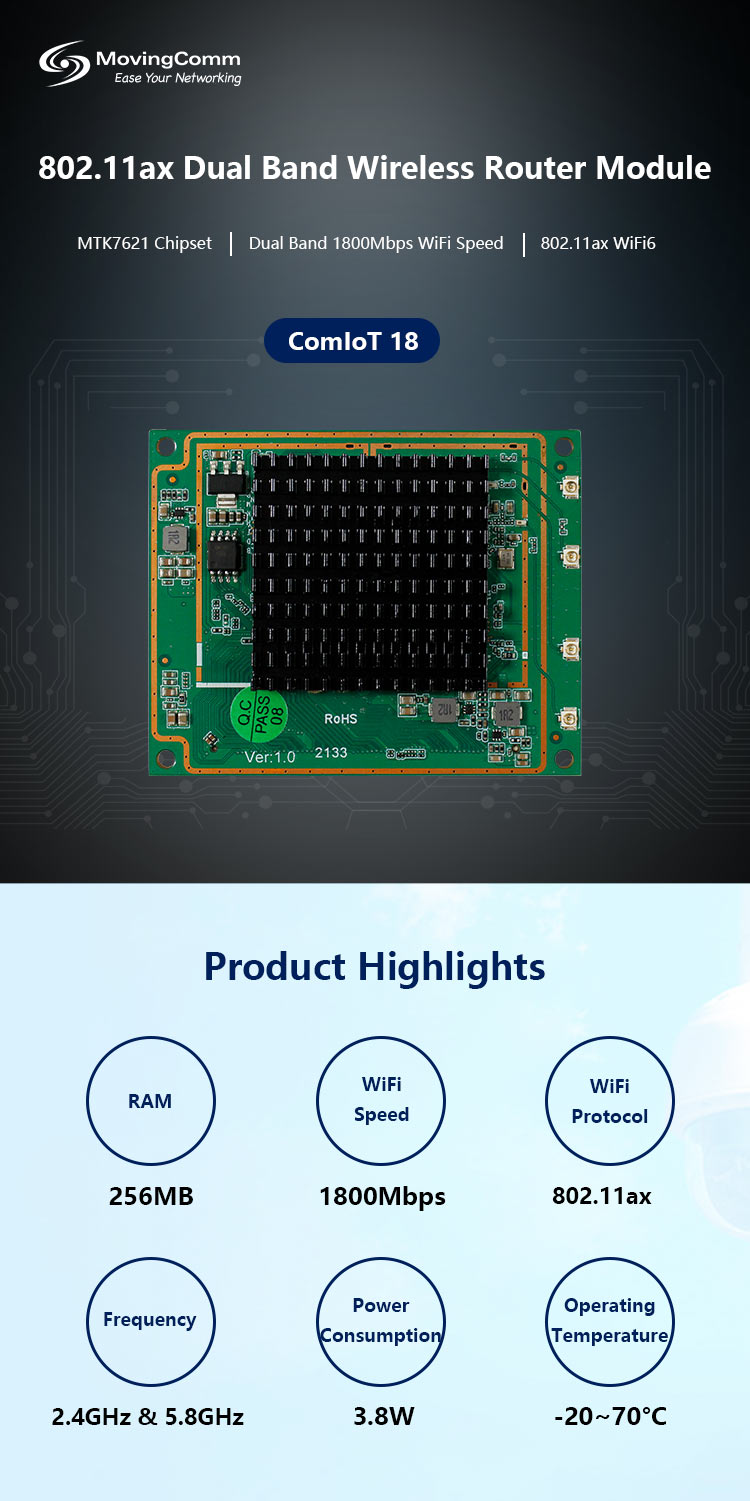
Wi-Fi is one of the most commonly used technologies in drone communications, supporting high-speed data transmission and short-distance communication. Wi-Fi 6 (802.11ax) further improves transmission rates and network capacity, making it suitable for multi-drone collaboration.wireless router module
Mesh network
The UAV forms a self-organizing network through the Mesh network, and each node (UAV) can act as a repeater, extending the communication range and improving the network reliability.dual band router module
Cellular network technology
4G LTE/5G
4G and 5G cellular networks provide drones with wide-area coverage and high-speed data transmission capabilities. The low-latency, high-bandwidth features of 5G are particularly suitable for real-time video transmission and remote control.
NB-IoT (Narrow Band Internet of Things)
Suitable for low-power, long-range drone applications such as environmental monitoring and agricultural inspections.
Satellite communications technology
Low Earth Orbit Satellite (LEO)
Low-orbit satellites provide global coverage for UAVs and are suitable for long-range missions, such as border patrol, maritime search and rescue.router core board
Geosynchronous satellite (GEO)
It provides a stable communication link, but the delay is high, which is suitable for the task with low real-time requirement.
Dedicated radio communication technology
Peer-to-peer communication (P2P)
Direct communication between UAVs and ground stations or other UAVs is suitable for small-range missions.
Software Defined Radio (SDR)
Multiple communication protocols can be realized through software configuration to improve communication flexibility.
Optical communication technology
Free Space Optical Communication (FSO)
Using laser or infrared light for high-speed data transmission, suitable for scenarios with high bandwidth requirements, such as high-definition video transmission.
Visible Light Communication (VLC)
Communication with LED light sources is suitable for short-range, low-power applications.
Ad Hoc technology
Flying Ad Hoc Network (FANET)
The dynamic networking between UAVs does not need to rely on ground infrastructure, which is suitable for collaborative tasks in complex environments.
Multihop communication
The UAV realizes long-distance communication through multi-hop relay to extend the coverage area.
Low power Wide Area Network (LPWAN) technology
LoRa
Suitable for long-range, low-power drone applications such as agricultural monitoring and logistics tracking.
Sigfox
Provide low-rate, long-distance communication services, suitable for small data transmission.
Hybrid communication technology
Multi-link fusion
Combine a variety of communication technologies (such as 5G+ satellite +Mesh) to achieve a highly reliable and high-bandwidth communication network.
Dynamic switching
Dynamically switch communication modes based on task requirements and environmental conditions to optimize network performance.
Artificial Intelligence and communication optimization
Intelligent routing algorithm
Use AI to optimize the communication paths of drone networks, reducing latency and increasing efficiency.
Spectrum sensing and dynamic allocation
AI senses spectrum usage in real time and dynamically allocates communication resources to avoid interference.
Application scenario
Military field
Uav cluster operations, reconnaissance and surveillance, electronic countermeasures, etc.
Civil domain
Disaster relief, environmental monitoring, logistics distribution, etc.
Commercial field
Agricultural plant protection, power inspection, film shooting, etc.
Future development trend
6G communication technology
6G will further enhance the communication capabilities of UAVs, supporting higher bandwidth, lower latency and wider coverage.
Quantum communication
Quantum communication technology is expected to provide an absolutely secure communication link for drones.
Edge computing
Edge computing is introduced into the UAV network to realize local data processing and reduce cloud dependence.
The diversity and innovation of UAV networking communication technology provide strong support for UAV application. With the continuous progress of technology, drones will play an important role in more fields, promoting the development of intelligence and automation.
