

In the digital wave sweeping the world today, the network has become an indispensable part of our life and work. From home entertainment to business operations, the need for connectivity everywhere is driving technological innovation. Traditional routers rely on wired network access, and in recent years, with the rapid development of 4G/5G technology, routers without network cables - especially 4G/5G cellular routers - are gradually becoming the new darling of the connected world.
Technical secrets: How 4G/5G cellular routers work
4G/5G cellular routers, as the name suggests, are devices that utilize a mobile communications network (4G LTE or 5G NR) as a data transmission channel. They have a built-in SIM card slot and connect to the Internet through mobile network base stations, which in turn provide connected devices with network access through Wi-Fi or other wired interfaces. Compared with traditional wired routers, the biggest feature of this type of router is its mobility and flexibility, which is not limited by geographical location and wired network wiring.
4G/5G technology Foundation: 4G LTE provides high-speed mobile Internet access, while 5G has achieved a qualitative leap in speed, capacity and latency, providing a solid network foundation for high-definition video streaming, telemedicine, autonomous driving and other application scenarios.
When a user device (such as a smartphone, computer) is connected to a 4G/5G cellular router, the router will convert the 4G/5G signal into a Wi-Fi signal for multiple devices to use at the same time. This process involves multiple steps such as signal reception, data decoding, internal processing and re-encoding into a Wi-Fi signal.
advantage analysis: Why choose 4G/5G cellular router?
Flexible deployment: No need to lay network cables, as long as there is 4G/5G signal coverage can be quickly deployed, especially suitable for temporary locations, remote areas or frequently changing network environments.
Mobile working: For individuals and teams who travel frequently or work remotely, 4G/5G routers ensure a stable, high-speed Internet connection anywhere.
Emergency backup: In the event of a primary network failure, 4G/5G routers can be used as a backup network solution to ensure business continuity, especially for critical infrastructure and industrial environments.
Cost-effectiveness: For small businesses or home users, high cable network installation and maintenance costs are avoided, and initial investment costs are reduced.wireless router
Application scenario: Unlimited possibilities of 4G/5G cellular routers
Home and office: Provide convenient wireless Internet access for home users to meet the daily entertainment and learning needs; Businesses can take advantage of its flexibility to quickly set up temporary office networks.
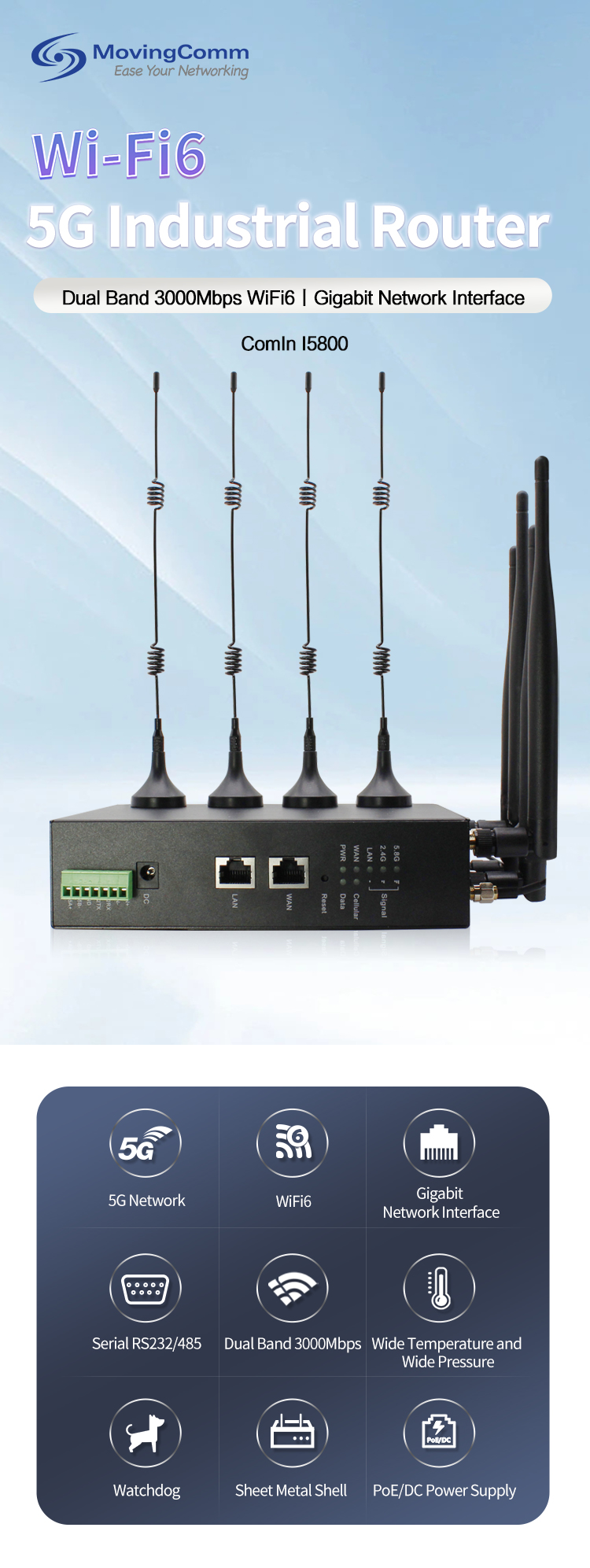
Industrial Internet of Things: In intelligent manufacturing, smart cities, agricultural monitoring and other fields, 4G/5G industrial routers with their high reliability, low power consumption and wide coverage capabilities have become the key to connecting iot devices such as sensors and controllers.
Outdoor activities and travel: Camping, adventure, long-distance travel, 4G/5G router allows you to enjoy high-speed network services away from the hustle and bustle of the city, and share the wonderful moments of the journey.
Emergency and temporary facilities: For natural disaster relief sites, temporary exhibitions, sports events and other occasions, rapid deployment of network solutions is essential, and 4G/5G routers are ideal.
the actual use experience: the convenience and challenge of not inserting the network cable
Although 4G/5G cellular routers bring unprecedented convenience, in actual use, users also need to pay attention to the following points:
Network speed and stability: While 5G technology significantly improves network speed, in some remote or densely populated areas, signal strength and network speed may be affected. Therefore, it is particularly important to choose a router that supports multi-band and has intelligent signal optimization technology.5G industrial router
Data traffic management: Using the mobile network means that you need to watch your data usage and avoid overspending your plan limits. Some routers provide traffic monitoring and management functions to help users plan traffic properly.
Security considerations: Wireless networks are more vulnerable to hacking than wired networks. Ensuring timely update of router firmware and enabling strong password protocols such as WPA3 are basic measures to ensure network security.
Cost considerations: Although initial deployment costs are low, mobile data costs can become a significant expense over the long term, especially for users with high traffic requirements.
Conclusion: Embrace the future, the router without the network cable is the right time
To sum up, 4G/5G cellular routers, with their unique flexibility, wide applicability and continuously optimized performance, are gradually changing the way we connect. Whether home, enterprise or industry-specific applications, they are showing great potential and value. Of course, with the continuous progress of technology and the further reduction of costs, the application of 4G/5G cellular routers will be more extensive in the future, and the user experience will be more perfect. In this era of the Internet of everything, the unplugged router is undoubtedly an important step towards a more free and efficient digital life. Let us look forward to this new era full of infinite possibilities.industrial router
