

While consumers are still wondering whether to upgrade their WiFi 7 router, the industry's eyes are already looking further into the future - WiFi 8 (IEEE 802.11bn). This standard is called "the next revolution in wireless networks" by the industry, not only pushing speed to new heights, but also "stability" and "reliability" as the core, completely rewriting the application logic of smart home, industrial interconnection and XR (Extended Reality). This paper analyzes why WiFi 8 is worth looking forward to from three aspects: technical features, scene adaptation and industry trends.
WiFi 7 vs. WiFi 8: It's not just about speed
The commercialization of WiFi 7 (IEEE 802.11be) is just beginning, and its core advantages are 46 Gbps theoretical peak speed, 320MHz ultra-wide band and 4096-QAM modulation technology, which significantly improves the concurrency of multiple devices5. But the goal of WiFi 8 has shifted from "faster" to "more stable and reliable."
Speed and throughput: The actual throughput of WiFi 8 is expected to increase by more than 80% compared to WiFi 7, especially in high-density scenarios (such as stadiums, smart factories).
Band coverage: WiFi 8 supports 2.4GHz, 5GHz, 6GHz three bands to work together, can dynamically allocate spectrum resources, reduce signal interference.
Core mission: WiFi 8 pays more attention to the stability of user experience, and makes the theoretical value of the laboratory closer to the real scene performance through technical optimization.
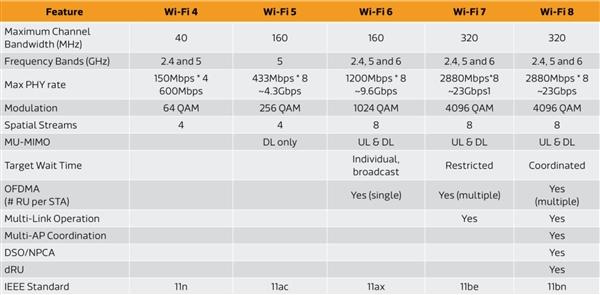
Three technological breakthroughs for WiFi 8
Ultra-high Reliability (UHR)
WiFi 8 introduces the "ultra-high reliability" design standard for the first time, enabling more accurate signal transmission between routers and devices through coordinated spatial multiplexing (Co-SR) and Coordinated beamforming (Co-BF). For example, in a home environment, when multiple smart devices are working simultaneously, signal interference can be reduced by more than 50%.
Dynamic Spectrum Allocation (DFS)
While the spectrum allocation of traditional WiFi is fixed, WiFi 8 can adjust the sub-channel resources in real time according to the network load. For example, when someone in the home is live streaming and someone is playing a game, the router automatically allocates more bandwidth for high-priority tasks, increasing overall throughput by 15%-25%.5G Industrial Router
Multi-access point intelligent collaboration
WiFi 8 allows multiple routers or access points to work together to form a "seamless roaming network." For example, in a large shopping mall or office building, when the user moves, the device automatically switches to the node with the strongest signal, and the delay fluctuation is almost imperceptible.wireless router
Who needs WiFi 8? A comprehensive upgrade from home to industry
Family scene:
Smart home: supports the stable connection of over 100 devices, and the data packet loss rate of key devices such as smart door locks and cameras is close to zero.
XR Entertainment: Applications such as 8K VR live streaming and holographic calling require ultra-high bandwidth and low latency, and the throughput of WiFi 8 reduces the dependence on local hardware.
Enterprise scenario:
Industrial automation: Robotic arm collaboration, real-time monitoring systems in factories require high network reliability, and WiFi 8's UHR features meet millisecond response requirements.
Smart city: Intensive networking of traffic lights and environmental monitoring equipment requires efficient spectrum utilization, and dynamic allocation technology can alleviate urban network congestion.
Challenges and future prospects of WiFi 8
Cost and adoption cycle
The first WiFi-8 supporting routers and terminal devices are expected to be available in 2028, with high initial prices (expected to be 30%-50% more expensive than WiFi 7 devices), and need to support the 6GHz band policy.
Deep integration with AI
WiFi 8 or the introduction of AI algorithms to achieve network fault self-repair, traffic prediction and other functions. For example, by learning user habits, more bandwidth is automatically allocated to security cameras at night.
The birth of WiFi 8 marks a new stage in wireless networks from "speed race" to "experience optimization". For ordinary users, WiFi 7 is still the cost-effective choice in the next 3-5 years; However, for enterprises and high-demand users, the advance layout of WiFi 8 ecology (such as compatible chips and network architecture) will seize technical dividends.industrial router
The birth of WiFi 8 marks a new stage in wireless networks from "speed race" to "experience optimization". For ordinary users, WiFi 7 is still the cost-effective choice in the next 3-5 years; However, for enterprises and high-demand users, the advance layout of WiFi 8 ecology (such as compatible chips and network architecture) will seize technical dividends.industrial router
