

In today's digital age, routers have become indispensable devices for connecting to the Internet. Whether it is a home, enterprise or industrial scenario, routers play a vital role. However, different scenarios have different requirements and functional requirements for routers.
Family use: convenience and stability
For home users, the main function of the router is to provide a stable wireless network so that family members can smoothly carry out online activities, such as browsing the web, watching videos, playing games, etc. The application of 4G router in the home is mainly reflected in the following aspects:
Alternative in non-broadband environments: In some remote areas or places where broadband coverage is not complete, 4G routers can be used as an alternative to broadband. By inserting a SIM card, users can use the 4G network to achieve wireless Internet access without complex broadband cabling.4G Industrial router
Temporary network needs: For renting or temporary living families, 4G routers can quickly build a wireless network environment. For example, in the scenario of student dormitories or short-term rental sharing, 4G routers can avoid the tedious and expense of broadband installation, while meeting basic network needs.Industrial router
Home network expansion: In some homes, there may be incomplete broadband signal coverage, such as basements, balconies and other areas. At this time, the 4G router can be used as a signal repeater to convert the broadband signal to 4G signal, and then extend to these areas through the WiFi function of the 4G router.
Enterprise use: High efficiency and security
The needs of enterprises for routers are more complex and diversified, which not only requires stable and efficient network connections, but also has high requirements for security. The application of 4G routers in enterprises is mainly reflected in the following aspects:
Small office network setup: For some small businesses or startups, 4G routers can quickly set up an efficient office network. Through the wired and wireless interfaces of 4G routers, enterprises can simultaneously connect multiple office devices, such as desktops, laptops, printers, etc., to achieve rapid data transmission and sharing.
Convenient choice for mobile office: In the case of frequent business trips or mobile office, the 4G router can provide a stable network connection. Employees only need to carry equipment such as 4G routers and laptops, and can work anywhere there is a 4G signal, regardless of geographical location.
Enterprise network backup scheme: For some enterprises with high requirements for network stability, 4G routers can be used as a backup scheme for broadband networks. When the broadband network fails or is unstable, the 4G router can quickly switch over to ensure the continuous operation of the enterprise network and avoid losses caused by network interruptions.wireless router
Industrial use: reliability and durability first
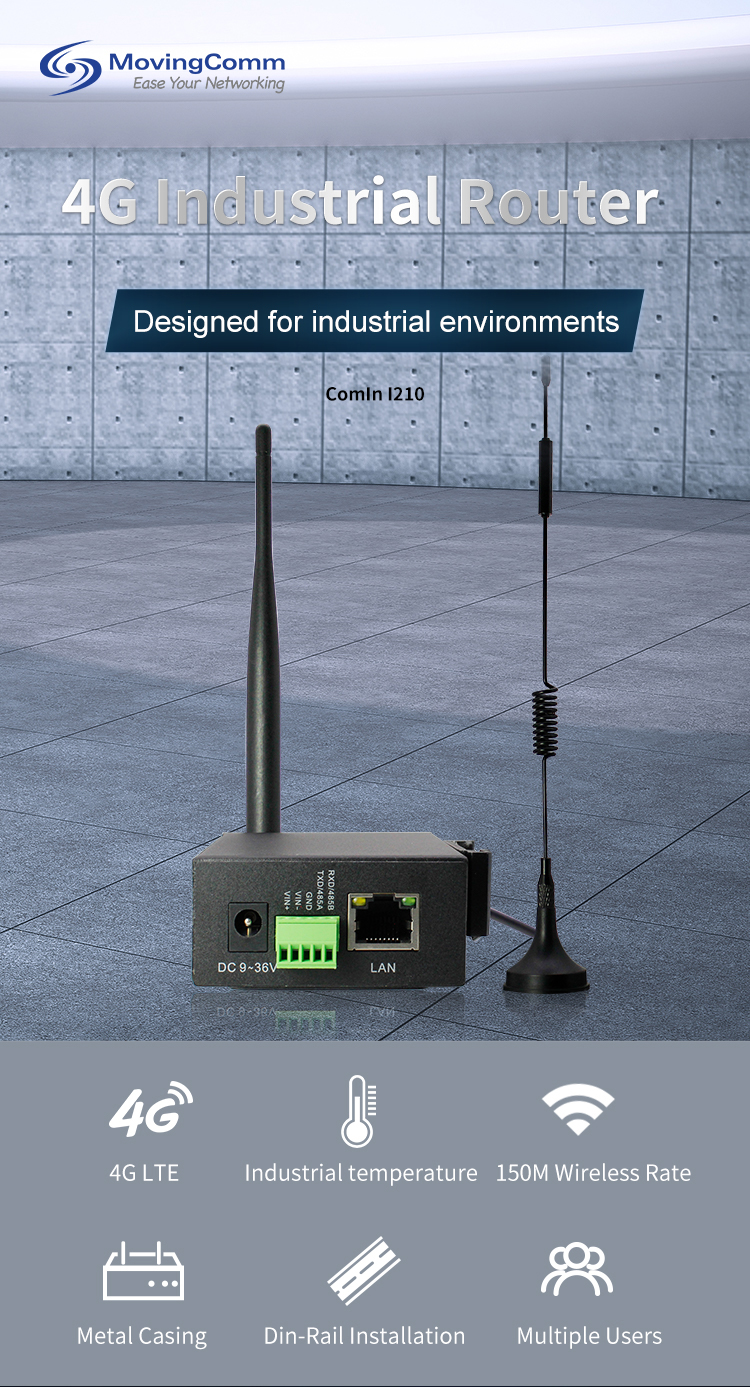
In the industrial field, routers are usually used for remote monitoring, data transmission and automatic control of equipment. These scenarios have high requirements for the reliability and durability of the router. The application of 4G routers in industry is mainly reflected in the following aspects:
Remote monitoring and data transmission: In some remote industrial equipment installation sites, such as oil fields, mines, wind farms, etc., 4G routers can achieve remote monitoring and data transmission of equipment. Through the 4G network, the staff can obtain the operating status and data information of the equipment in real time, and carry out fault diagnosis and maintenance in time.
Industrial automation control: In industrial automation production lines, 4G routers can connect a variety of sensors, controllers and actuators. Through the stable 4G network, the collaborative work and automatic control between the devices are realized, and the production efficiency and product quality are improved.
Network protection in harsh environments: the industrial environment is usually harsh, and there may be high temperature, low temperature, high humidity, strong vibration and so on. 4G routers need to have good protection and durability to adapt to these environmental conditions and ensure the stable operation of the network.
 To sum up, 4G routers have their unique application value and applicability in different scenarios such as home, enterprise and industry. Although the needs and functional requirements of routers in different scenarios are different, 4G routers can meet the basic needs of most scenarios by virtue of their convenience, efficiency, stability and security. However, when choosing a 4G router, users also need to consider the performance parameters, functional characteristics, brand reputation and after-sales service factors of the router according to the specific use scenario and needs to ensure that they choose the most suitable product for themselves.
